About accessories
Both the transmitter and locator are compatible with a wide range of accessories.
When an accessory is connected, the locator or transmitter will recognize it and will enable the mode appropriate to the accessory.
Radiodetection supply an accessory sheet with pictures and details of all applicable accessories which is available on www.radiodetection.com
Transmitter clamps
The transmitter clamp fits around a pipe or cable and safely applies a signal to a live insulated cable without interrupting or disconnecting the supply. The clamp applies a very discriminating signal to a target line with reduced coupling to other lines. A clamp can sometimes be a more effective method of applying the signal than Direct Connection.
The target line will carry the strongest signal. The other lines will carry the weaker return signal. If the system comprises only two conductors, they may carry equal signals.
WARNING! Do not clamp around uninsulated live conductors.
WARNING! Before applying or removing the clamp around a power cable, ensure that the clamp is connected to the transmitter at all times.
The clamp may buzz or vibrate if it is placed around a power cable that has significant net current flow. This is normal and does not harm the equipment.
Connecting the clamp
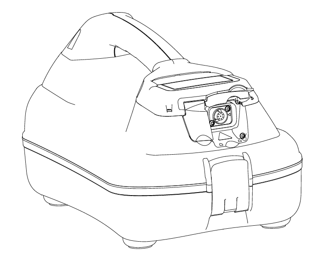
Transmitter output socket
- Plug the clamp into the transmitter output socket.
- Put the clamp around the pipe or cable and ensure that the jaws are closed. Switch the transmitter on.
The display will show the Clamp connected icon
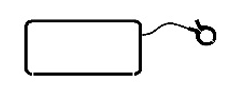
Clamp connected icon
The line should be grounded (earthed) on each side of the clamp for the signal to transfer to the line. Ground the line if necessary. An insulated cable may be traced even if it has no actual ground connection, providing a reasonable length is buried either side of the clamp to provide capacitive coupling to ground (earth).
NOTE: It is not necessary to make a ground connection from the transmitter when using the clamp.
Transmitter clamp range
Although transmitter and locator clamps look the same, they have different internal windings. To prevent the wrong clamp being connected, transmitters and locator clamps have plugs of a different orientation.
Standard signal clamps
The standard clamps apply the transmitter signal very selectively and effectively to a target cable up to 130mm (5¼”) in diameter using frequencies from 8kHz to 200kHz.
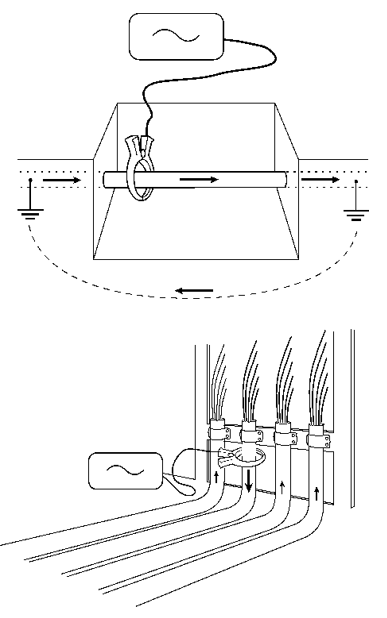
Connecting transmitter clamps
The standard and small clamps have a double spring action for positive toroidal contact.
WARNING! The transmitter must only be connected to live services using the appropriate accessory such as a plug connector or live cable connector.
Transmitter external power supply
The external Mains or vehicle power supplies provides an alternative and convenient method of powering the transmitter.
WARNING! The mains power supply rating are: 100-240VAC, 1.3A. Always use an adequately rated detachable mains lead.
WARNING! The mains power supply is not IP rated and should not be used in wet locations.
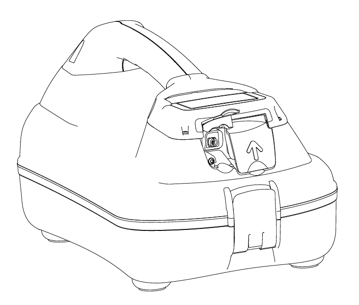
Transmitter DC Input
To use the mains or vehicle power supply units connect them to the DC input socket in the transmitter before connecting them to the mains or vehicle supply socket.
WARNING! The mains PSU supply cable is the disconnecting method for isolating the unit from the main supply.
WARNING! The battery compartment lid is the disconnecting method for isolating the unit from the battery supply.
WARNING! Do not position the equipment so it is difficult to disconnect the unit from each supply.
WARNING! Protection will be impaired if used in a manner not specified.
Flexitrace
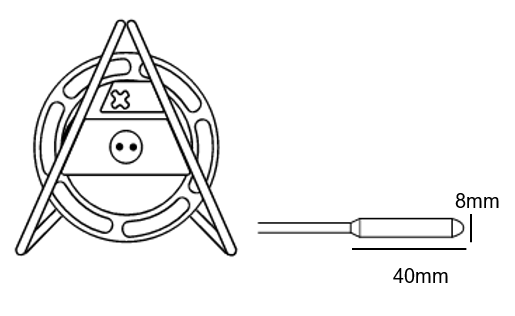
The Flexitrace is a traceable plastic covered fiberglass rod incorporating wire conductors and is used for locating small diameter, non-metallic pipes to a depth of 3 meters. The Flexitrace can be inserted into a pipe or duct as small as 9mm / 3/8” internal diameter, and it has minimum bend radius of 250mm. Batteries are not required, as the FlexiTrace is powered by any Radiodetection transmitter.
The FlexiTrace has a maximum power rating of 1W. When using the FlexiTrace with a Radiodetection Tx-5 or Tx-10 transmitter the output limit must be set to 1W in the MAX P menu and the output voltage limit set to LOW in the MAX V menu.
WARNING! Failure to follow the Tx-5 or Tx-10 instructions above may result in the tip of the FlexiTrace becoming too hot to touch, resulting in risk of personal injury and damage to the equipment.
The FlexiTrace can be used in two modes: Sonde mode or Line mode. In sonde mode only the tip of the FlexiTrace is energized whilst in line mode its whole length is energized.
To use as a sonde, connect both transmitter leads to the FlexiTrace stud terminals. As the FlexiTrace terminals are not color coded it does not matter to which terminals the leads are connected. To use the FlexiTrace in line mode, connect the red transmitter lead to one of the FlexiTrace terminals and connect the black transmitter lead to a suitable ground connection.
FlexiTrace
Submersible antenna
When to use a submersible antenna
Tracing buried pipes and cables across waterways and estuaries are frequent and critical locating applications. Less frequent but equally important is tracing and locating lines between the mainland and offshore islands. When locating pipes and cables the locator sensing antennas should be as close as possible to the target line so it is not practical to locate lines buried under a river or seabed from the surface. In most cases, it is necessary to measure the depth of cover to ensure the line is protected from dragging anchors or other underwater hazards.
The submersible, double depth antenna is suitable for use under water for tracing pipes or cables. There is a weight at the bottom of the antenna for stability and the unit has been pressure tested to IP68 to a depth of 100m (300ft).
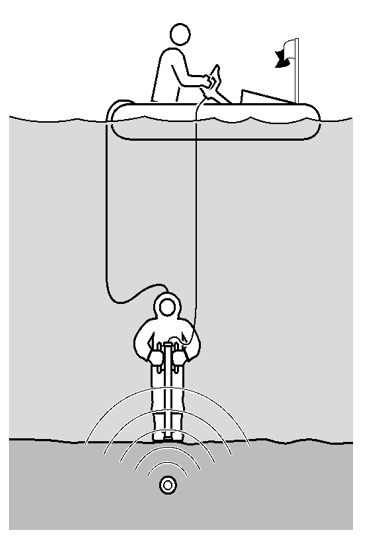
The antenna is supplied with 10m of submersible marine umbilical cable as standard, but lengths of up to 100m can be supplied. The extra length enables the antenna to be carried by a diver on a riverbed or seabed while the locator is used in a surface vessel. It is crucial to have effective communication between the operator with the locator and the diver with the antenna.
Alternatively the antenna can be fastened to the end of a non-metallic boom from a barge and lowered to the riverbed or seabed.
How to use a submersible antenna
Apply the transmitter signal to the target line at an access point on the shore. The submersible antenna line for tracing the line underwater is plugged into the accessory socket of the locator. The locator is used onboard a boat, which should by positioned directly over the line. The transmitting signal should be applied by Direct Connection with the strongest possible signal and at the frequency that the submersible antenna is calibrated to. Make a ground connection about 50m (160ft) from the transmitter. Test the quality of signal on the line before locating on the water.
NOTE: The submersible antenna is calibrated to work at one frequency.
Tips for using a submersible antenna:
The user in the boat should be a specialist or have considerable experience using a locator so that they can give concise instructions to the diver.
It is prudent for the pair to practice working together on dry land before attempting to locate underwater. Using the antenna the diver should locate and trace a known line blindfolded receiving directions from the user with the locator out of sight of the line and the diver.
Because of rapid signal loss and a combination of large surface area and very conductive soil there may be problems applying a suitable signal for tracing a large diameter pipe. It may be necessary to use a high power, low frequency tracing signal.
It is necessary to define a method of recording target line position and depth before starting work in the boat or on the seabed.
Using a submersible antenna
WARNING! Only properly licensed and experienced divers should attempt to use the submersible antenna.